Read the workflow
Inspect executable code and four or six binary component changes.
Public task + two free anchors WhatWorkedBenchGitHub
 A BENCHMARK FOR EXPERIMENTAL UNDERSTANDING
Every experiment reveals a result.
What does the agent learn about why it works?
Measure how accurately AI agents predict the effects of component changes after a limited number of experiments.
Executable workflows · Complete references · Open evidence
01 / THE PROTOCOL
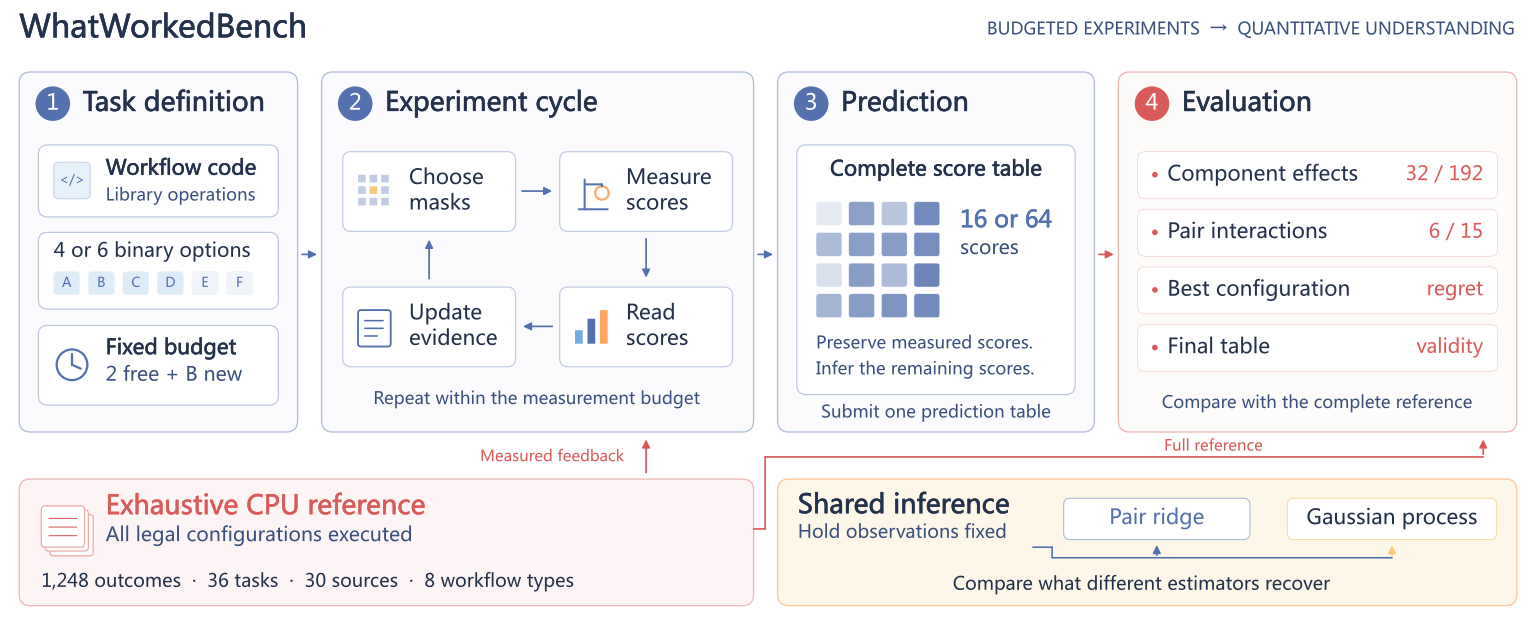
From observations to a complete predictionAn agent studies a workflow, chooses configurations to measure, and submits predictions for every possible configuration. Exhaustive CPU execution supplies the ground truth.
Inspect executable code and four or six binary component changes.
Public task + two free anchorsSelect experiments. Observe scores. Adapt the next measurement.
B additional measurementsSubmit a complete table covering all 16 or 64 configurations.
Measured scores stay fixedEvaluate component effects, interactions, and configuration choice.
Complete native reference02 / INSIDE A REAL TASK
Interactive · Recorded native outcomesExplore the SciFact retrieval task. Select a component, change its background, and see how its measured effect changes. Every score below comes from the released reference.
The selected component changes from off to on. All other options define the background.
Eight backgrounds, eight conditional effects. Highlighted bar shows your selection.
NDCG@10 measures retrieval ranking quality. Reference scores use the fixed 64-query SciFact evaluation cohort. Inspect the task ↗
03 / THE EVIDENCE
4,206 numerical controls · 108 core agent episodesShared inference reconstructs the response surface from an agent's existing observations. Code-aware modeling also uses visible equivalences between configurations.
Effect recovery increases when a Gaussian process reconstructs the agent's acquired evidence.
Repeated episodes retain the separation between collecting observations and using them effectively.
This comparison changes acquisition and inference using equivalences derived from visible code.
Three beat-detection and three graph-link-prediction sources. Effect recovery improves for all six valid submissions.
Structure diagnostic0.338 → 0.507Eight complete episodes show how a post-hoc code-equivalence projection improves effect recovery with the acquired observations held fixed.
Higher effect recovery indicates more accurate conditional-effect predictions. Cohorts retain their original identities and comparison units. Inspect complete results ↗
04 / THE TASK COLLECTION
Native CPU workflows · Four or six optionsFrom retrieval and regression to signal processing and graph prediction, every task exposes executable component choices and complete outcome references.
36 conditions on 30 sources. Six paired variants extend existing tasks to six options; 96 configuration records repeat original subcube outcomes. Source attribution ↗
05 / GET STARTED
Python 3.11+ · Linux · Offline numerical evaluationRun a numerical baseline, replay native outcomes, or connect your agent to the budgeted evaluator.
Read the integration guide ↗THE PAPER
Benchmarking Experimental
Understanding in AI Agents
The preprint link and finalized paper citation will appear here.
@misc{whatworkedbench2026,
  title = {WhatWorkedBench: Benchmarking
    Experimental Understanding in AI Agents},
  year = {2026},
  howpublished = {Software repository},
  url = {https://github.com/EthanNing/WhatWorkedBench}
}